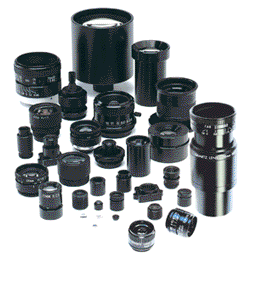
Custom lens assemblies play a critical role in advancing medical imaging systems, enabling sharper diagnostics and more reliable treatment decisions. While standard lenses serve many applications, the complexity of today’s diagnostic tools often demands tailored optical solutions designed for specific imaging environments. High-resolution custom assemblies ensure superior image clarity, precise integration with medical devices, and the durability required in sensitive applications such as endoscopy, X-ray scanning, and diagnostic camera systems.
The Need for Custom Lens Assemblies in Medical Imaging
Standard lenses are designed for general-purpose use, but medical imaging often requires highly specific optical performance. Diagnostic equipment must capture fine details, operate under unique lighting conditions, and fit seamlessly into compact or vibration-sensitive devices. In such cases, off-the-shelf lenses can limit clarity, precision, or system compatibility.
Key limitations of standard lenses:
- May not deliver the resolution needed for advanced diagnostic imaging.
- Lack of compatibility with specialized medical devices or housings.
- Limited durability in high-use or sterilization-required environments.
- Restricted customization in focal length, field of view, or magnification.
Growing Demand for Tailored Solutions in Advanced Diagnostic Equipment
As medical imaging systems evolve, so does the need for custom optical solutions. From minimally invasive endoscopes to high-resolution diagnostic cameras, precision optics directly impact the quality of patient care and the effectiveness of medical procedures.
Drivers of demand for custom assemblies
- Increasing use of compact and portable diagnostic tools.
- Advanced imaging modalities requiring specialized focal lengths.
- Rising adoption of CMOS and CCD sensors in medical systems.
- Expansion of non-invasive imaging methods that require precise optics.
Benefits of Customization: Optimized Performance, Integration, and Durability
Custom lens assemblies provide performance advantages that extend beyond imaging quality. They are engineered to integrate smoothly with specific devices and withstand the rigorous conditions of medical use, from repeated sterilization to constant handling.
Benefits of custom lens assemblies include:
- Optimized performance: Enhanced resolution, reduced distortion, and sharper image quality.
- Seamless integration: Designed to fit precisely with unique housings and imaging systems.
- Durability: Built to endure frequent sterilization, vibration, and high usage in clinical settings.
- Scalability: Can be produced in small or large quantities depending on device needs.
Types of Lens Assemblies for Medical Systems
CCD/CMOS Lens Assemblies
CCD and CMOS lens assemblies are widely used in modern digital diagnostic cameras. They deliver the resolution required to visualize organs, tissues, and other critical anatomical details in real time.
Key features of CCD/CMOS assemblies:
- High-resolution imaging that supports clear and accurate diagnostics.
- Flexible resolution options: low, medium, and high to meet system requirements.
- Compatibility with advanced sensors used in portable and stationary medical devices.
CCTV Lens Assemblies
CCTV lens assemblies support live monitoring and diagnostics, enabling physicians to observe internal processes without invasive procedures. By providing a clear view of internal organs, they improve diagnostic accuracy and patient care.
Benefits of CCTV lens assemblies:
- Help reduce the need for exploratory surgery by offering non-invasive visualization.
- Enable innovative treatment options guided by live imaging.
- Improve precision in monitoring conditions and selecting appropriate therapies.
Key advantages include:
- Specialized optical coatings and materials for radiation resistance.
- High precision to ensure accurate scanning and analysis.
- Robust design for reliability in clinical and laboratory applications.
Design and Manufacturing Capabilities
Custom lens assemblies for medical imaging benefit from an integrated design and manufacturing approach, ensuring precision, speed, and reliability.
Capabilities include:
- Custom design process: From concept through prototyping and production, tailored to each device.
- Full engineering support: Expert consultation, including focal length calculators and system integration guidance.
- In-house advantages: Faster turnaround, strict quality control, and consistent optical performance.
- Extensive inventory: Over 1,600 lenses in stock, enabling rapid fulfillment and reducing downtime for medical projects.
Key Benefits of Custom Lens Assemblies in Medical Imaging
Improved Diagnostic Accuracy
Custom lenses are designed to capture fine anatomical details that standard lenses might miss. This results in sharper, higher-contrast images that allow physicians to make more accurate diagnoses with greater confidence.
Advantages:
- Enhanced resolution for detecting small lesions or abnormalities.
- Reduced image distortion and noise.
- Better differentiation of tissue structures and densities.
Seamless Integration with Specialized Equipment
Medical imaging systems vary widely in design and application. Custom lens assemblies ensure compatibility with unique housings, sensors, and diagnostic platforms.
Advantages:
- Tailored focal lengths and fields of view.
- Precision alignment with CCD/CMOS sensors.
- Reliable performance in compact or portable medical devices.
Enhanced Durability and Reliability
Medical environments place high demands on optical components, including frequent sterilization and long operational hours. Custom lens assemblies are engineered for resilience in these conditions.
Advantages:
- Resistance to vibration, temperature fluctuations, and radiation.
- Robust housings for long-term use in clinical settings.
- Materials and coatings optimized for repeated sterilization cycles.
Optimized Performance for Specific Applications
Unlike standard lenses, custom assemblies can be engineered for very specific imaging needs, from endoscopy to X-ray scanning.
Advantages:
- Tuned optical performance for low-light or high-radiation conditions.
- Specialized coatings to reduce glare, reflection, or scatter.
- Consistent imaging quality across a wide range of diagnostic uses.
Scalability and Cost Efficiency
Custom does not necessarily mean costly. Manufacturers can provide lens assemblies in the exact quantity needed, making them viable for both niche devices and large-scale production.
Advantages:
- Flexible production runs, from prototypes to full-scale manufacturing.
- Long-term cost savings through improved efficiency and reduced replacements.
- Access to existing stock libraries (e.g., 1,600+ lenses ready for deployment) to shorten lead times.
Expert Support and Engineering Guidance
Working with a specialized optics partner ensures that medical device manufacturers receive technical expertise alongside high-quality lenses.
Advantages:
- Consultation with experienced optical engineers.
- Use of focal length calculators and simulation tools.
- Guidance through selection, design, and integration.
Custom lens assemblies are transforming the future of medical imaging by delivering precision, reliability, and tailored performance that standard lenses often cannot achieve. From endoscope couplers to CCD/CMOS and X-ray systems, these solutions enhance diagnostic accuracy, reduce invasive procedures, and ultimately support better patient outcomes. Partnering with an experienced manufacturer ensures that medical professionals receive lenses designed to meet the unique demands of advanced imaging systems.
Discover how Universe Kogaku can design the perfect custom lens assembly for your medical imaging needs, contact us today.