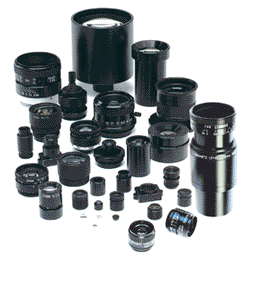
What we see with the human eye is only a fraction of the electromagnetic spectrum. Beyond visible light lies a vast range of non-visible light, from ultraviolet and infrared to radio waves, X-rays, and gamma rays, that powers modern science and technology. With the help of specialized high-resolution and custom lenses, industries can harness these hidden wavelengths for imaging, inspection, spectroscopy, and medical innovation, turning the invisible into actionable insights.

Electromagnetic Spectrum

The electromagnetic spectrum includes all forms of electromagnetic radiation, from the longest radio waves to the shortest gamma rays. What separates one type of radiation from another is its wavelength, frequency, and energy, which determine how it behaves and how it can be applied in technology, medicine, and industry.

Electromagnetic Radiation as Waves

  • Electromagnetic radiation consists of oscillating electric and magnetic fields that move together through space.
  • These waves travel at the speed of light (about 300,000 km/s in a vacuum).
  • The type of radiation is defined by its wave characteristics, which affect how it interacts with matter.

Wavelength, Frequency, and Energy

Wavelength (λ): The distance between two wave crests.

  • Long wavelengths = low frequency (e.g., radio waves).
  • Short wavelengths = high frequency (e.g., X-rays).

Frequency (ν): The number of wave cycles passing a point each second, measured in Hertz (Hz).Infrared Tech

Energy (E): Directly proportional to frequency, expressed as E = hν (Planck’s equation).

Higher frequency = higher energy radiation.

Example: Ultraviolet carries more energy than visible light, which is why it can damage skin cells.

Types of Non-Visible Light

The electromagnetic spectrum beyond the visible range contains several forms of non-visible radiation, each with distinct wavelength ranges, energy levels, and applications.

Ultraviolet (UV) Light

Wavelength Range: ~10–400 nanometers (shorter than violet light).

Subtypes:

  • UVA (315–400 nm): Long-wave UV; penetrates deep into the skin, linked to premature aging.
  • UVB (280–315 nm): Medium-wave UV; main cause of sunburn and skin cancer risk.
  • UVC (100–280 nm): Short-wave UV; mostly absorbed by the ozone layer but used in sterilization lamps.
  • Ozone Role: The ozone layer absorbs ~97–99% of solar UV radiation, especially UVC and most UVB.

Applications

  • Medical: Sterilization and disinfection of equipment.
  • Industrial: Forensics, counterfeit detection, curing of adhesives/inks.
  • Everyday: Blacklight effects in entertainment and security printing.

Infrared (IR) Light

Wavelength Range: ~700 nm – 1 mm (longer than red light).

Subcategories

  • Near IR (700–1400 nm): Used in fiber-optic communication and remote controls.
  • Mid IR (1400–3000 nm): Key in spectroscopy for chemical identification.
  • Far IR (3000 nm – 1 mm): Closely associated with heat radiation and thermal imaging.
  • Thermal Emission: Objects emit infrared radiation based on temperature; this is the basis of thermal cameras.

Applications

  • Industrial: Quality control, material testing, and automation.
  • Scientific: Astronomy (detecting celestial heat signatures).
  • Military/Forensic: Night vision and surveillance.

Radio Waves

Wavelength Range: ~30 cm to several kilometers (longest EM waves).

  • Frequency Range: 3 Hz – 300 GHz.
  • Communication: Radio, TV broadcasting, GPS, Wi-Fi, and mobile networks.
  • Scientific: Radio astronomy for mapping galaxies.

Special Note: Harmless at normal exposure levels but can interfere with electronic equipment at high intensities.

Microwaves

Wavelength Range: ~1 mm – 30 cm.

  • Frequency Range: 300 MHz – 300 GHz.
  • Cooking: Microwave ovens excite water molecules in food.
  • Telecom: Used in satellites, radar, and wireless broadband.
  • Medical: Certain therapeutic heating devices.

Biological Consideration: Excessive exposure may heat deep body tissues, raising health concerns for unprotected workers near high-power transmitters.

X-Rays

Wavelength Range: ~0.01–10 nanometers.

Frequency/Energy: Very high frequency; capable of penetrating soft tissues.

Applications

  • Medical Imaging: Detecting bone fractures, lung infections, dental scans.
  • Security: Baggage scanners at airports.

Safety Concerns

  • Overexposure damages tissues and DNA.
  • Strict shielding and controlled exposure are mandatory in medical and industrial use.

Gamma Rays

Wavelength Range: Less than 0.01 nanometers (shortest waves, highest energy).

Origin: Emitted during nuclear decay, supernovae, and particle interactions.

Applications

  • Medicine: Cancer treatment (radiotherapy) and sterilization of medical instruments.
  • Science: Astrophysics for studying cosmic events.

Risks: Highly penetrating; prolonged exposure is lethal. Specialized shielding (e.g., lead or concrete) is required.

Importance of Non-Visible Light

While invisible to the human eye, non-visible light plays a critical role across science, technology, and daily life. From powering telecommunications and medical diagnostics to uncovering hidden details in forensic investigations and expanding our understanding of the universe, these wavelengths extend human capability far beyond natural vision.

Contribution to Science and Technology

Spectroscopy and Material Science

  • UV light reveals electronic transitions in molecules for chemical fingerprinting.
  • IR spectroscopy detects vibrational modes to identify molecular bonds.

Telecommunication Systems

  • Radio waves form the backbone of terrestrial broadcasting and satellite signals.
  • Microwaves enable point-to-point data transfer, radar navigation, and 5G networks.

Advanced Imaging Technologies

  • X-ray imaging provides sub-millimeter resolution of dense materials and biological tissues.
  • Infrared imaging detects heat leaks in buildings and electrical faults in machinery.

Industrial, Medical and Forensic Applications

Industrial Uses

  • Infrared sensors identify overheating components in engines and circuits.
  • UV fluorescence highlights stress fractures in metals and composite materials.

Medical Applications

  • X-rays diagnose fractures, tumors, and lung infections.
  • Gamma rays sterilize surgical instruments and target cancerous cells during radiotherapy.
  • Infrared thermography screens for circulatory disorders by mapping temperature anomalies.

Forensic Applications

  • UV illumination exposes fingerprints and traces of bodily fluids not visible to the eye.
  • IR imaging reveals overwritten or erased text in historical and legal documents.
  • X-ray scanning inspects sealed packages for concealed drugs, weapons, or explosives.

Role in Astronomy and Space Exploration

Infrared Astronomy

  • Identifies star-forming regions obscured by cosmic dust.
  • Detects exoplanets through their thermal emissions.

Radio Astronomy

  • Tracks cosmic microwave background radiation from the Big Bang.
  • Studies emissions from pulsars, quasars, and galactic centers.

High-Energy Astronomy

  • X-ray telescopes map black hole accretion disks and neutron stars.
  • Gamma-ray observatories detect supernova remnants and gamma-ray bursts, the universe’s most energetic events.

Capturing Images in Non-Visible Light

Capturing images beyond the visible spectrum requires specialized optics and imaging technologies that can transmit, filter, and detect wavelengths invisible to the human eye. These tools are essential in fields such as forensics, astronomy, industrial inspection, and medical diagnostics.

Special Lenses and Sensors

  • Conventional glass lenses are limited in transmitting ultraviolet (UV) and infrared (IR) wavelengths.
  • Quartz, fluorite, and other optical materials are specifically engineered to transmit non-visible light with minimal distortion.
  • Sensors must be adapted to detect longer or shorter wavelengths, since standard camera sensors are typically designed to block IR and UV radiation.

Example: Quartz Lenses for UV/IR Imaging

  • Quartz lenses are highly transparent to UV and IR light, making them ideal for capturing images outside the visible range.
  • Applications include forensic imaging (detecting hidden residues), scientific research (observing UV fluorescence or IR thermal patterns), and industrial inspection (quality control under non-visible illumination).

Filters and Refractors for Wavelength Isolation

  • Optical filters are used to isolate narrow bands of light, such as UV-only or IR-only ranges, for precise imaging.
  • Refractors bend and split light, allowing instruments to capture images at specific wavelengths while blocking unwanted radiation.
  • Narrowband filters (~10 nm) are critical for monochromatic imaging, such as in laser systems or spectroscopy.

Though invisible to the human eye, non-visible light is vital across science, medicine, industry, and space exploration. From UV sterilization to infrared imaging and radio communication, these wavelengths expand human capability while requiring specialized optics and careful safety measures. Harnessing them continues to drive innovation and discovery.

Contact Universe Optics today for precision-designed standard and custom lenses that make the invisible visible.