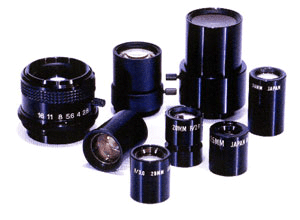
In modern robotic medicine, the quality of a lens can define the quality of a procedure. From minimally invasive surgeries to advanced diagnostic imaging, high-resolution optics give surgeons the depth, clarity, and precision they need to work with absolute confidence. The right lens turns complex anatomy into clear, actionable visuals, helping reduce risk and improve outcomes. As robotic-assisted technologies continue to evolve, selecting the right lens for medical technology has become a key factor in pushing medical innovation forward.

The Role of Lenses in Robotic Medical Systems

In robotic-assisted surgery, the quality of the lens determines the accuracy of the surgeon’s view and, ultimately, the success of the procedure. Whether guiding a robotic arm inside a patient’s abdomen during laparoscopic surgery or navigating a microsurgical tool across the surface of the retina, the lens is the surgeon’s direct link to the surgical field.

Imaging as the Driving Force in Robotic Surgeries

In robotic systems such as the da Vinci Surgical System or PRECEYES Surgical System, the surgeon never directly touches the patient’s tissue, their control is entirely dependent on what the camera and lens capture.

  • Enhanced Depth Perception: 3D high-definition lenses allow precise spatial awareness, crucial for avoiding nerve damage or delicate vessels.
  • Real-Time Responsiveness: Instant image transmission ensures the surgeon’s movements align perfectly with what’s displayed on the console.
  • Detailed Tissue Visualization: Specialized coatings and high-contrast optics make it easier to distinguish between similar-looking structures, like the bile duct and cystic duct in gallbladder surgery.

Machine Vision Systems

hires

hires

  • Detects micro-changes in tissue color and texture that may indicate complications.
  • Maintains sharp focus even during instrument vibration or rapid repositioning.
  • Supports integration with AI-assisted recognition, enabling automated alerts for critical anatomical structures.

Medical Imaging (CT, MRI, Microscopy)

High-end diagnostic equipment demands lenses that can handle diverse imaging environments and high magnification without losing clarity.

  • Provides radiologists and surgeons with detailed cross-sectional imagery for pre-surgical planning.
  • Captures more “slices” in 3D imaging, improving the accuracy of virtual reconstructions.
  • Maintains optical sharpness during microscopy for microvascular and cellular-level surgery.

Surgical Navigation and Endoscopic Visualization

Endoscopic procedures depend on miniature lenses that can operate in low-light, moisture-prone environments inside the human body.

  • Delivers distortion-free visuals even at extreme close range.
  • Offers wide field-of-view optics for navigating complex anatomy without frequent repositioning.
  • Enables immersive 3D visualization so surgeons can gauge depth while operating through incisions as small as 5–10 mm.

The Cost of Poor Lens Quality in Surgery

A poorly designed or low-resolution lens can compromise both surgical accuracy and patient safety.

  • Misidentification of Anatomy: In gallbladder surgeries, unclear imaging can lead to mistaking the bile duct for the cystic duct, causing life-threatening complications.
  • Extended Procedure Times: Blurred or low-contrast visuals slow surgeon movements and decision-making.
  • Increased Risk of Nerve or Vessel Damage: Lack of precise depth cues can cause accidental contact with critical structures.
  • Reduced Value of Robotic Systems: Even the most advanced robotic platform becomes ineffective if its optical components fail to deliver.

Requirements for Robotic Surgery Lenses

Robotic-assisted surgical systems can only be as accurate as the images they deliver. The demands on a lens in this environment are extreme, it must function flawlessly under bright surgical lighting, in low-light endoscopic conditions, during rapid instrument movements, and through repeated sterilization cycles.

High Resolution – Capturing Fine Anatomical Details

  • Provides surgeons with ultra-sharp imagery of microscopic structures, such as small vessels, nerve fibers, or retinal tissue.
  • Allows for accurate tissue differentiation, critical when working near delicate or high-risk areas.
  • Ensures no loss of detail during zoom or magnification adjustments.

Example: In retinal microsurgery, sub-micron precision demands resolution that can reveal even the smallest hemorrhage or membrane.

3D and High-Definition Capability – Enabling Depth Perception

  • Delivers stereoscopic imaging for accurate spatial awareness inside the surgical field.
  • Enhances the surgeon’s ability to judge distances and angles during complex maneuvers.
  • Improves hand-eye coordination in minimally invasive procedures where direct vision is impossible.

Example: 3D laparoscopic cameras project real-time HD images, helping surgeons avoid inadvertent damage to surrounding organs.

Low Distortion – Preserving Anatomical Accuracy

  • Maintains true-to-life proportions, preventing spatial misinterpretation of anatomy.
  • Reduces edge warping and curvature effects that can mislead the surgeon’s view.
  • Ensures accurate navigation in robotic systems integrated with mapping or navigation software.

Example: In neurosurgery, low-distortion optics are critical when working in millimeter-scale spaces where mapping precision is essential.

Vibration Resistance – Maintaining Clarity in Motion

  • Stabilizes images despite natural instrument vibrations or patient movement.
  • Prevents blurring during rapid repositioning of surgical instruments.
  • Works in harmony with robotic system stabilization algorithms for smooth image delivery.

Example: In robotic-assisted cardiac surgery, vibration-resistant lenses ensure clear visualization despite constant subtle motion from a beating heart.

Sterilization Compatibility – Withstanding Harsh Cleaning Protocols

  • Endures repeated autoclaving, chemical sterilization, and high-temperature cleaning without degrading optical performance.
  • Maintains coating integrity to ensure consistent light transmission and anti-fog properties.
  • Designed with materials resistant to corrosion, moisture ingress, and heat damage.

Example: Lenses used in reusable laparoscopes must retain clarity after hundreds of sterilization cycles in high-temperature steam environments.

Custom Design – Tailored for Specific Medical Applications

  • Adjusted focal lengths for unique surgical needs (e.g., ultra-close focusing in ophthalmology vs. wide-angle in general surgery).
  • Specialized coatings to improve contrast, repel fluids, or block specific wavelengths.
  • Form factor optimized for compact integration into surgical instruments or robotic arms.

Example: The PRECEYES retinal surgery robot uses custom optics designed for ultra-fine manipulations inside the eye, paired with high magnification and minimal light loss.

Lens Technologies in Modern Robotic Surgery

Modern robotic surgery relies on specialized lens technologies that go beyond simple image capture. These lenses are engineered to provide high-definition clarity, depth perception, and functional imaging capabilities that directly impact surgical performance. Each technology addresses specific procedural needs, from complex laparoscopic operations to delicate microsurgeries.

3D Laparoscopic Lenses – Enhancing Depth Perception

  • Designed to deliver stereoscopic, high-definition images that replicate natural human depth perception.
  • Essential for minimally invasive surgeries where visual access is limited to a monitor.
  • Reduces surgeon fatigue by providing realistic spatial awareness, improving accuracy during complex maneuvers.

Example: High-definition 3D laparoscopic cameras project real-time, full-motion images onto large surgical displays, enabling surgeons to navigate organs, vessels, and tissues with unmatched precision.

Robotic Ophthalmic Surgery Lenses – Ultra-Precise Micro-Optics

  • Engineered for extreme magnification and clarity in microsurgical procedures, such as retinal repairs or vascular reconstructions.
  • Capable of resolving details at the sub-micron level, far beyond what the naked eye can achieve.
  • Minimizes optical distortion, ensuring accurate targeting of surgical instruments in delicate environments.

Example: The PRECEYES Surgical System uses custom-engineered lenses to provide ultra-high precision in retinal surgery, enabling controlled micro-manipulations that are impossible with manual hand movements alone.

Fluorescence Imaging Lenses – Visualizing Blood Flow and Perfusion

  • Equipped to work with specialized imaging dyes that fluoresce under specific light wavelengths.
  • Allows surgeons to see live blood flow, tissue perfusion, and duct structures during an operation.
  • Improves decision-making by highlighting critical anatomy in real time.

Example: The da Vinci Fluorescence Imaging Vision System, used in gallbladder surgery, displays blood flow in green and poorly perfused tissue in gray, helping surgeons avoid damage to the bile duct and other critical structures.

Microscopy Lenses for Pediatric and Micro-Surgery – Extreme Precision in Small Spaces

  • Designed for surgeries involving very small anatomical structures, such as tiny blood vessels or nerve fibers.
  • High numerical aperture and magnification capabilities ensure sharp visualization at close working distances.
  • Often integrated into robotic arms for enhanced stability and control.

Example: KidsArm, developed for pediatric surgery, uses a stereo camera system with microscopy-grade lenses to create a 3D point cloud of the surgical site, guiding the robotic arm for precise suturing of minuscule vessels.

In robotic-assisted medicine, clear and accurate imaging is essential. The right lens technology ensures surgeons see every detail, work with precision, and make better decisions in the operating room. As robotics continue to advance, high-performance lenses will remain a key factor in improving surgical outcomes and expanding what’s possible in modern healthcare.

Universe Optics designs the precision lenses that bring medical robotics into perfect focus.